Most operators now own the same tools. The exit premium is not going to the ones who have them. It is going to the ones who have paired them with a location that can actually capitalise on them.
Two Things Are Doing the Work, Not One
Ask an operator what has changed in self storage over the past three years and the list is long: mobile access, dynamic pricing, remote monitoring, AI-assisted enquiries and growing interest in self-storage as an alternative real estate investment. Over 90% of European self storage businesses now use AI in some form. Mobile-based access rose from under 40% of stores to 56% in a single year. Ask an investor what that list is worth on its own, and the answer is not much. The mobile access, dynamic pricing and basic AI that used to separate a well-run operator from the rest have stopped being scarce faster than most investors have finished pricing them as an advantage.
None of this works in isolation. Site visibility is the most common source of awareness of a store, but awareness is not the same as an enquiry: a separate survey question on how customers actually chose the store they contacted found only 20% already had a location in mind, against a full 68% who found it through search instead. Location builds the awareness; technology converts it, and each can fail without the other. A store invisible from the street rarely enters the search at all, and a store that is visible but has no online booking can lose the customer to whichever competitor answers first.
Savills, the sector's leading European adviser, makes the same pairing explicit every quarter it reports: outperformance sits with operators combining granular, catchment-level market analysis with data-led pricing, scale and technology, not with either discipline alone. The real question is not whether technology matters. The adoption numbers already settle that. It is what kind of advantage a widely-owned tool can still provide, and where.
The Technology Nearly Every Operator Now Owns
Split the technology by what each piece actually does, and the picture sharpens. Frictionless booking and remote, unmanned operation do not win a sale. They smooth the path to one that the location has already generated. The evidence shows where that limit sits: adoption runs highest, and works best, in markets where customers are already comfortable transacting without a person on site. Sweden's largest operator has retrofitted its whole portfolio with electronic locks for unattended access, and it is far from alone, with remotely managed stores rising sharply across the Nordics generally. The same pattern runs in reverse in markets still building trust in the category, where a walk-in still closes more sales than a booking link does. No reliable, per-customer acquisition-cost figure exists publicly, but the available evidence supports a narrower conclusion: remote-only is a market-fit decision, not a universal upgrade, and not a cost saving to bank on outside the markets where it already works.
Dynamic pricing and search visibility sit in a different category entirely. The primary role is not cost saving. They capture more of the demand a location already generates, adjusting rates by unit type and live demand signals rather than a fixed quarterly review. That makes technology a revenue lever here, not a margin one, and the distinction matters. Technology does not invent dynamic pricing (operators have adjusted rates manually for years), it sharpens it, and the best performers now deliver existing-customer rate increases above 15% that consistently outpace inflation. That durability is what the market prices at exit: a buyer confident that income will keep outrunning inflation pays a lower exit yield for the asset.
The one place a cost claim genuinely holds is the building itself. Automated lighting, smart heating and cooling, and monitoring reduce running costs in a way that is general to efficient buildings rather than specific to self storage, and adoption already shows it: 89% of European stores now use LED lighting, and over a third have installed solar. Savills is explicit that pairing the technology with these efficiency measures is what shows up in the operating line. It is a real saving, and the only one of the three that behaves like a margin argument rather than a revenue or conversion one. It is also the smallest of the three, and rarely the reason a given deal works.
The same technology changes what proximity is worth to a customer, not just what a store costs to run. A unit within walking distance plausibly gets visited more often than one requiring a drive, and easier access plausibly supports both retention and a customer's tolerance for the price they pay, though this has not been isolated cleanly in any published data. What is better evidenced is the technology that makes proximity useful rather than merely convenient: mobile access without a staffed desk, in-app inventory so a customer can check what they hold without a site visit, and flexible unit sizing that lets a need as small as a few boxes be served economically. These are the tools that let a small, local footprint behave like a full-service one, which matters more as urban catchments densify and larger sites become harder to secure.
A growing layer of specialist software providers is now putting the same pricing and data tools within reach of small and mid-sized operators too, narrowing the gap in tooling that used to separate scale players from the rest. The tools themselves no longer separate anyone. The separation shows up elsewhere, and not yet in the operating numbers.
The Gap the Transaction Market Has Already Priced
European self storage still has considerable room to grow. Continental Europe holds roughly 0.03m² of self storage per person, against 0.65m² in the US and 0.09m² in the UK. Germany sits almost exactly on that continental average, and Austria alongside it. Portugal is a step earlier again, a still-developing market where supply is only just beginning to catch up with demand. That gap is not a weakness in any of these markets. It is the opportunity, and it is the setting in which that divide matters most: where a category is still being built out, the difference between stock that is well fitted and well placed, and stock that is neither, has the furthest still to run.
No European source yet publishes lease-up speed, revenue per square metre or income quality broken out by how well a store is fitted with technology. That gap in the evidence is worth stating plainly rather than working around: forcing a number into it would be worse than admitting it is not there. What does exist, consistently, across three consecutive Savills updates, is evidence that the market for how these assets change hands, the transaction market, is already sorting stock into two tiers on exactly this basis. Demand is concentrated on institutional-grade facilities; the market for older, undifferentiated stock is described as inconsistent, and trading at softer pricing. Exit yields have compressed to around 5%, against 6% or higher for secondary stock, a gap that has widened as portfolios have scaled and institutional capital has become a bigger share of the buyer pool. A quarter earlier, Savills described the same pattern in different words: modern, well-positioned facilities risk out-positioning older stock, in a market that is bifurcating by quality.
That is the connection worth making. A buyer underwriting an asset today is not waiting for a controlled study of technology's effect on lease-up. They are pricing the asset against what a lender, and eventually another buyer, will make of its location and its fit-out at the next sale. Lenders already say as much directly: the sharpest pricing and the highest leverage go to scaled operators with proven, technology-enabled track records in well-chosen catchments. Whichever asset merely runs the newest software does not get the same terms. Location complemented by technology, not either alone, is producing that divide, and the transaction market has already started pricing it even though the operating data has not caught up to prove it.
What a Converted Building Carries Forward

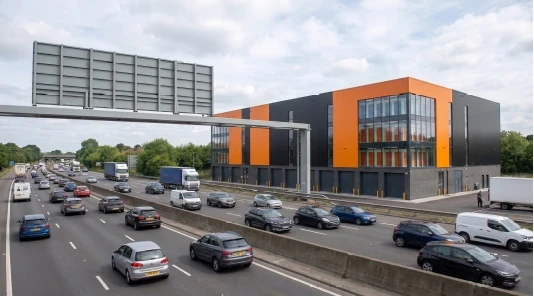
Land is already the constraint that makes this urgent. Rising land cost is now the single largest concern for European operators, cited by 41% of them, up 23 percentage points in a single year, with planning difficulty close behind. Converting an existing building into self storage looks like an obvious answer to that constraint, though the real advantage is not the one most commonly cited. The case for conversion is risk and timing, not cost. A converted building carries less exposure to planning refusal, moves through entitlement faster, and reaches locations a new-build application would struggle to win before the land is gone. Leasehold structures, commonly used for exactly this kind of urban conversion, now make up a growing 20-25% of the sector, against freehold's continued 70-80% majority.
Most of the technology travels with the building. Access control, remote monitoring, cloud-based pricing and booking, and camera-based monitoring all sit on software and light hardware; they retrofit into almost any existing shell. What does not travel is dense, robotic racking, which needs its floor loading and ceiling height decided before the first wall goes up, and which remains rare even in the warehouse industry it was built for, present in perhaps 3-5% of warehouses generally. That divide is the clearest way to frame conversion: not the cheap route to the same building, but the fast, lower-risk route to nearly the same technology-fitted asset, with the highest-end automation the one piece that it cannot yet take on.
Reuse carries a second advantage that has nothing to do with speed. Retrofitting an existing building saves the embodied carbon a new structure would lock in before a single unit is let, and RICS treats reuse as typically the lowest-carbon option available for exactly that reason: the structure and materials are already on site. Precise savings vary too much by project to state with confidence. What is measurable is what happens once the building is running: LED lighting is now close to standard across the European stock, and solar generation has moved from a minority feature to one used by over a third of operators. Rooftop capacity and battery storage remain underused relative to the space available on most of this stock, an unclaimed opportunity that the sector's next chapter on energy will need to take up properly.
What Comes Next, and What the Capital Is Already Rewarding
The technology already in the ground is not the end state. Revenue management is moving from dynamic pricing within guardrails toward genuine demand forecasting, with staffing and capital decisions increasingly informed by predicted occupancy rather than last month's actuals, and renewal churn reduced by digital wallets that remove friction from the moment a payment is due. Maintenance is following the same arc, from reactive to predicted, with connected systems starting to flag gate faults and water ingress before they become call-outs. At least one operator has already put autonomous security drones into daily use across its portfolio, launching from a rooftop dock to patrol and inspect without a person on site, a smaller step than it sounds once the access and monitoring layer is already digital.
Further out, and drawn deliberately from adjacent industries rather than self storage itself, the ceiling looks higher still. Automated storage and retrieval, racking to considerable height and moving stock by robot rather than by aisle, already at least triples density against conventional shelving in the warehouses it was built for, and at least one manufacturer now sells a version sized specifically for urban self storage sites where land is the binding cost. The load itself stays entirely manual, even at the most automated site: a customer still wheels every box from car to unit. A robotic intake bay at the entrance could take over instead, scanning, cataloguing and placing each box without the customer ever reaching the storage area. What keeps this a decade or two out rather than sooner is everything that will not box: furniture, appliances, anything too large or oddly shaped, which is a harder robotics problem than the pallets warehouses already handle. Automation could go further than access too: warehousing and manufacturing already run sites lights-out, with robots handling routine faults and minor repairs without a person on site. Self storage has automated who comes through the door, not yet who looks after the building once they have left.
Storage already doubles as a back office for resale businesses, and some operators already let couriers collect parcels directly from reception rather than requiring a drop-off elsewhere, operators responding to what these tenants actually need rather than a built product. Nobody has yet turned that into a full service, with the operator handling pick, pack and shipping itself, which would mean taking on a logistics business rather than just hosting one. The furthest reach on this list, cameras that know what is inside a unit well enough to price insurance against it, or a drone that can place an item as well as it can now watch one, asks two industries to solve a problem neither has solved alone. That makes it worth watching, not yet worth underwriting.
Put the pieces together, and the shape of the opportunity is exactly what the transaction market is already pricing. Consolidation is no longer a forecast: private equity now accounts for around 60% of European transaction volume, up sharply from a market once dominated by REITs and institutions, and Savills expects platforms exceeding 500 facilities within a decade. It is not confined to one country either, operators are already crossing borders into the same developing, under-penetrated markets described above, capital acting on the growth-runway argument rather than just describing it. That broader investor interest is also part of the reason self storage has increasingly found a place within diversified real estate investment portfolios, where investors are evaluating the asset class not simply as individual facilities, but as part of a wider property strategy. Lenders are pricing the identical shift from the other side: the sharpest terms and the highest leverage go to scaled operators with a proven track record in well-chosen locations, not to whichever asset merely looks the most modern.
The direction of evidence is increasingly clear. Technology is close to universal, and the transaction market is already sorting stock into two tiers on the strength of what it is paired with, not the technology alone. The real question is not whether that divide is real. It is whether the capital moving into self storage now arrives with locations disciplined enough to capture it, rather than mistaking either half, the technology or the location, for the whole story. That pairing, not either half alone, is what is widening the gap between modern and older stock, and it is the gap the transaction market is already pricing. The capital that captures it is not the capital that bought the most technology. It is the capital that bought the right locations, and gave them the technology to prove it.